
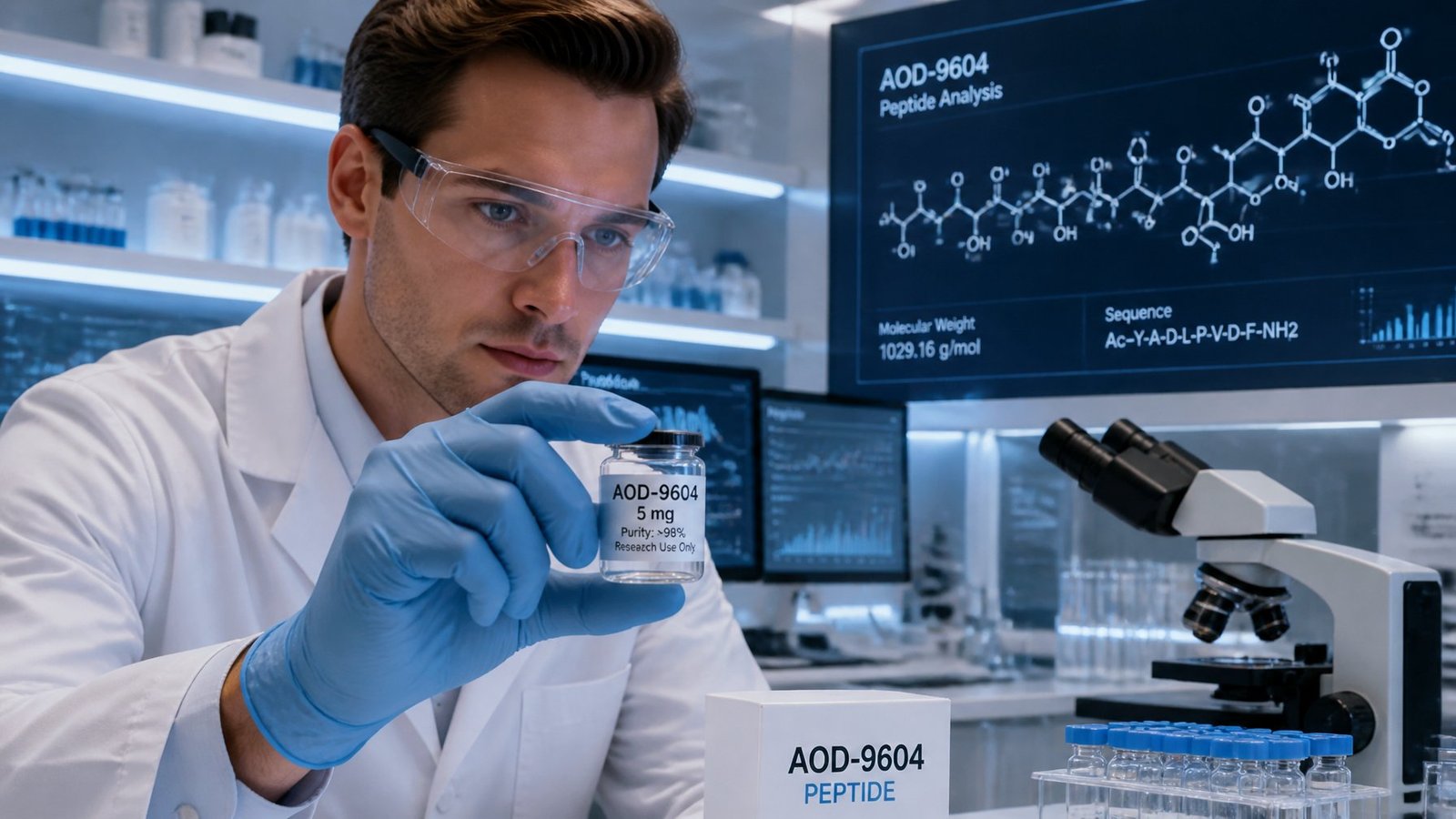
The research community remains highly focused on AOD-9604 due to its place in fat-metabolism studies. While buyers often sort through listings for an AOD-9604 research chemical, analyzing actual data yields far more value than chasing exaggerated marketing narratives.
Essentially, this synthetic option serves as a targeted fragment cloned from human growth hormone (hGH), specifically matching the C-terminal end. Labs run tests with it to chart lipid handling, fat oxidation, and lipolysis pathways.
However, we must confirm one legal reality immediately. No regulatory board approves AOD-9604 for weight management, obesity control, or consumer cosmetic change. It holds zero therapeutic green lights. The compound belongs strictly inside a controlled lab setting, far away from retail supplement stores.
For procurement managers and laboratory buyers, the true assessment requires answering basic questions. What does the baseline evidence outline? How does the hypothesized mechanism actually function? What applications show scientific logic? What documentation checks must happen before running an assay? This overview unpacks those realities using a direct, data-first perspective.
The Origins and Structure of AOD-9604
Structurally, AOD-9604 mirrors a specific, isolated zone known as the hGH 177-191 region of human growth hormone. Developers introduced structural updates to help the peptide maintain stability during standard laboratory handling.
The goal here centers on isolation. Full human growth hormone modifies multiple biological mechanisms simultaneously, impacting things like systemic growth, IGF-1 signaling, fluid levels, and insulin responses. Scientists isolated this short terminal section to determine if a smaller fragment could trigger specific fat handling pathways without activating the wide, systemic side effects of the complete parent hormone.
Interest traces back to older data detailing the C-terminal end’s role in adipose tissue behavior. Investigators wanted to know if an isolated peptide chain could alter fat storage processes or accelerate cellular oxidation. This specific structural layout explains why the compound populates academic reviews surrounding metabolic paths and cellular signaling. Still, no laboratory should mistake it for a finished clinical therapy. Its primary utility rests in mapping molecular responses.
Mapping the Existing Study Data
The actual trial literature on AOD-9604 remains highly mixed and demands cautious analysis. Preclinical animal models provide the foundation for most existing data. These rodent studies tracked shifts in weight gain, cellular adipose activity, and general fat oxidation. Certain early models noted changes in lipid markers and overall weight accumulation, which initially built the global interest surrounding this fragment.
Experiments also evaluated how AOD-9604 interfaces with cellular mechanisms tied to lipolytic signaling. A handful of papers indicate the peptide might modify anti-lipogenic actions within localized fat tissue. Separate teams checked for links to beta-adrenergic signaling networks, particularly via beta-3 adrenergic receptors in obese animal setups.
However, laboratory success in cell cultures or rodent models rarely matches human outcomes. Compounds frequently demonstrate massive potential in controlled animal environments but fail to deliver stable, meaningful actions inside human clinical trials. This exact breakdown impacts AOD-9604. Human efficacy documentation remains sparse and completely lacks the statistical power required to back consumer statements. For accurate scientific guides, the core conclusion remains simple: AOD-9604 provides an intriguing window into metabolic mechanisms, but it is not a validated human fat-loss agent.
Proposed Cellular Mechanism: How It Functions
The technical concept behind AOD-9604 links straight to standard lipid metabolism. Investigators center their attention on how this compound impacts two distinct metabolic actions:
Lipolysis: The cellular process where the body breaks down stored fat deposits into individual fatty acids.
Lipogenesis: The biological pathways responsible for building and packing away new fat storage units.
On a purely theoretical level, a compound capable of ramping up lipolysis while dampening lipogenesis would alter overall fat mass within test subjects. Because history associates the C-terminal piece of hGH with fat handling, developers built AOD-9604 to look exclusively at that target.
By avoiding the systemic paths of full growth hormone—such as glucose alterations or tissue proliferation—this fragment seeks to isolate metabolic signaling. Some animal tests suggest the peptide tweaks fat cell response, while other papers argue it stimulates beta-3 adrenergic pathways.
Even so, writers must keep descriptions grounded by using terms like “proposed” or “investigated.” Labeling these mechanisms as proven in human biology remains inaccurate. The most sensible path defines AOD-9604 as an experimental molecule used to chart lipid signaling responses.
Primary Lab Applications of AOD-9604
Testing facilities deploy AOD-9604 across several core areas of metabolic science:
Adipocyte Activity Mapping
Because baseline studies evaluated fat breakdown, labs use the fragment to watch how individual cells handle fat mobilization. It helps track shifting markers under tight experimental controls.
Obesity Model Testing
Preclinical setups routinely introduce AOD-9604 to animal models of obesity to see if the compound alters overall fat accumulation. These projects serve to map molecular pathways, not to pioneer a finished medical drug.
Fragment Structure Research
The molecule helps researchers analyze structure-activity rules in peptide biology. Utilizing a small segment allows teams to map precise cellular reactions without dealing with a whole hGH string.
Tissue Sensitivity Analysis
Adipose tissue acts as a highly active metabolic organ. Scientists include this fragment in trials measuring receptor pathways and molecular shifts within active fat cells.
Stability and Chemical Analytics
Chemistry labs use AOD-9604 to study standard peptide handling logistics. Analysts track degradation speeds, build purity testing matrices, and determine how to preserve delicate amino chains in storage.
Why Purity Controls Dictate Experimental Success
Purity stands as a mandatory technical metric for any research chemical, not a promotional talking point. Poor purity values create massive issues during data analysis. Contaminants inside a low-grade batch distort biological responses and ruin assay consistency.
A reliable research peptide demands verifiable, batch-specific paperwork. At a minimum, buyers require:
Batch-matched Certificate of Analysis (COA) sheets
Raw HPLC purity data charts
Mass spectrometry identity confirmation
Molecular weight validation
Real lot numbers and verified manufacturing dates
Most scientific settings demand a purity baseline of 98 percent or better. However, generalized statements mean nothing. Every purity metric must match the exact shipment delivered to the bench. HPLC calculates the general purity by separating the chemical components, while mass spectrometry confirms the molecule’s identity. Controlling impurities matters deeply because standard synthesis can introduce deletion sequences, truncated fragments, or oxidation issues. Small structural flaws ruin sensitive biological assays.
Handling and Long-Term Storage Baselines
Peptide links degrade quickly when exposed to bad environments. Temperature, light, moisture, and repeated freeze-thaw cycles break down their structural stability. Maintaining strict storage protocols is essential if you want reliable data.
Keep dry, lyophilized peptide powder sealed tight and cold. Standard lab routines store these powders in deep-freezer setups away from ambient light. Once a technician pops the vial’s seal, atmospheric humidity poses a major risk since moisture speeds up chemical breakdown.
Liquid solutions lose stability much faster than raw dry powder. Researchers typically split the liquid into small, single-use aliquots to avoid thawing and refreezing the same container. Doing that repeatedly shears the peptide links and destroys trial consistency.
Follow these baseline rules:
Keep dry powder sealed until the exact moment of reconstitution.
Keep vials protected from direct light and ambient moisture.
Avoid putting mixed solutions through multiple freeze-thaw cycles.
Run all steps using sterile handling equipment.
Log every aliquot with the creation date, concentration, and batch data.
Discard materials that show discoloration or unexpected cloudiness.
Regulatory and Safety Boundaries
Peptides are widely misunderstood by general readers, making careful language completely mandatory. Research chemicals do not equal consumer items. Nobody should ever promote AOD-9604 for personal consumption, sports enhancement, bodybuilding, or DIY fat-loss routines.
Health authorities frequently issue warnings regarding compounded or unapproved peptides. They list problems like immunogenicity risks, dangerous process impurities, a lack of human safety data, and general quality control flaws. Wording requires caution.
Athletes must realize that AOD-9604 populates anti-doping banned lists worldwide. Avoid any promotional language that encourages performance optimization or personal use. The default baseline is absolute: AOD-9604 is an experimental peptide for qualified laboratory testing only. It has zero approvals for human consumption, clinical use, or dietary supplements.
Evaluating an AOD-9604 Supplier
Look past the initial price tag when sourcing laboratory chemicals. Discount peptides missing clear lot data create massive head-scratchers when your assay findings go completely sideways.
A dependable source provides complete batch data, clear chemical labels, and solid technical support. The product page should explicitly state what the compound does, along with what it is not for.
Run these basic checks:
Does the provided COA match your exact lot numbers?
Did they verify purity via HPLC testing?
Is the identity locked down with mass spectrometry?
Are storage details fully provided?
Does the container carry a clear research-use tag?
Does the supplier avoid wild weight-loss promises?
Legitimate suppliers never promise rapid body transformations. Verified documentation and lot-level data are worth far more than marketing hype.
Conclusion
AOD-9604 remains a highly compelling peptide because it connects growth hormone fragments to lipid studies. Animal tests demonstrate some impact on lipolysis and fat cell oxidation. Yet human data remains flatly limited. Never market it as a proven fat-loss treatment.
Focus entirely on scientific accuracy, documentation, and responsible handling. Treat it purely as a research chemical for controlled lab environments. Drop the exaggeration. Highlight what the studies show, what remains completely unknown, and why quality control matters. That balanced approach preserves your scientific credibility.
FAQ
What is AOD-9604?
It is basically a custom laboratory fragment clipped straight from human growth hormone. Specifically, it targets how fat systems process nutrients and cellular responses within fat tissue models.
Is it approved for human use?
No, definitely not. AOD-9604 does not hold a single valid pharmaceutical clearance as a medication, clinical formula, or health supplement. It remains strictly a research compound.
What exactly is the main research interest?
Scientists track how it engages fat breakdowns, the pathways behind fat formation, and typical genetic signals inside active fat cells.
What purity parameters are expected?
Most testing facilities require a purity level hitting 98 percent or higher, verified cleanly by specific HPLC sheets and mass spectrometry graphs.
How do you handle the storage?
Keep your dry powder frozen, sealed completely tight, and dark. Try to never run your mixed liquid batches through standard freeze-thaw cycles repeatedly.
Can you use it for medical weight loss?
No. It does not exist as a verified weight management prescription. This study material belongs exclusively inside scientific papers and lab assays.
Why does the supplier documentation matter?
Peptide degradation or hidden synthesis flaws destroy lab results. Direct batch metrics like COA and mass specs eliminate that risk.
Contact Us for Research-Grade AOD-9604
Looking for AOD-9604 research chemicals with verified batch data and proper lab labels? Contact our team today to check lot availability and request COA sheets.