

The respiratory system is the first contact we have with the world. With each breath, lung tissue is constantly exposed to air as well as pollutants, allergens, microbes and inflammatory signals. BackgroundChronic respiratory diseases (CRDs), including asthma and chronic obstructive pulmonary disease (COPD), are global leading causes of disability-adjusted life years but current management strategies typically only provide symptomatic respite which does not treat the underlying ailing pathological morphology of bronchi and alveoli. As a result, researchers are investigating biological regulators —short naturally occurring peptides that may restore homeostasis after tissue trauma. One of the more intriguing candidates in this group is Chonluten, a synthetic tripeptide originating from bronchial tissue.
In this article we’ll run through the science behind Chonluten, how it compares to other Khavinson peptides and the potential benefits that research suggests along with why scientists looking for high-purity Chonluten trust Aries Peptide Research. This deep dive will take you through the world of peptide research, whether you’re new or a more experienced biologist needing reliable sources.
What is Chonluten?
Chonluten, or synthetic peptide T34*, is a tripeptide comprising amino acids Ala‑Glu‑Asp (also referred to as EDG). Isolated initially from bronchial mucosal tissue, it is considered a lung bioregulator. In the Aries product notes, Chonluten was studied for its “signalling properties related to respiratory tissue repair,” including signalling in bronchial and alveolar tissues. What it is supplied as: It comes in a lyophilized powder form at which can be reconstituted by researchers for in‑vitro experiments. Crucially, all batches are COA-verified and third-party tested for reproducible results built in at every stage of the traceability process from source to product.
The peptide is small enough that it gets through biological membranes quite easily. This has led researchers to study how Chonluten does exert control over gene expression. Several studies demonstrate that relatively small investigative peptides such as di- and tri-peptides have life-extending properties in experimental animal models, with multi-faceted effects including up to 40 % increase in lifespan and inhibition of spontaneous tumor development. They can even cross nuclear membranes and directly interact with regulatory regions of DNA. Chonluten is a member of this class of regulatory peptides, with the lung being its main target and a secondary effect in the GI tract.
Khavinson peptides and the broader research context
Chonluten belongs to a group of peptides (Khavinson peptides) developed by Dr Vladimir Khavinson from the St Petersburg Institute of Bioregulation and Gerontology[3]. These peptides comprise Vilon (a di‑peptide relevant for eye and brain regeneration), an example of a well-characterized regulator, Epitalon(a tetra-peptide widely investigated in the context of neuroendocrine functions). Khavinson peptides The 2022 study using several Khavinson peptides including Chonluten revealed that these molecules modulate some inflammatory processes and also cell proliferation in the immune cells. In the study, Chonluten induced phosphorylations of ERK1/2 an JNK, and decreased IL-6 and TNF-α in response to bacterial endotoxin. The Chonluten effects are indicative that it is not simply a structural fragment but involves the activation of intracellular pathways.
How does Chonluten work?
Modulating inflammatory and antioxidant genes
A hallmark of Chonluten is its ability to modulate the expression of genes associated with inflammatory and oxidative stress. Biotech Peptides is a scientific site that collects research which suggests that Chonluten could affect expression of DNA to help stabilize the mucosa lining in the bronchi. The bronchial mucosa exposes to injuries of inflammatory diseases such as asthma or COPD, which produces secretory mucus and defective barrier function. Chonluten acts to regulate gene expressions, which seems to restore bronchial mucosal function.
The peptide action is mediated through several key genes and proteins:
- c-fos – a proto-oncogene induced by stress. To prevent the thickening and aberrant proliferation of mucosal that contribute to COPD and asthma, researchers hypothesized whether c-Fos expression could be controlled.
- HSP70 – a heat–shock protein protecting from oxidative damage in cells. Chonluten may up‑regulate HSP70 to enhance the airways’ ability to cope with environmental stresses.
- SOD (superoxide dismutase) – by upregulating gene expression for antioxidant enzymes, Chonluten can terminate reactive oxygen species and counteract chronic inflammation.
- COX‑2 and TNF‑α both inflammatory mediators. Chonluten has reported normalizing their expression, suppressing chronic bleeding.
These cumulative impacts lead to a profile that is stress-protective, as well anti-inflammatory. In fact, it is the peptide maintaining performance under hypoxic conditions that has created interest for supportive roles in respiratory infections, including COVID‑19.
Modulation of cytokine secretion and cellular signaling
n that previously mentioned International Journal of Molecular Sciences study, THP‑1 macrophage cells were treated with Chonluten and other Khavinson peptides. Chonluten was demonstrated to induce phosphorylation of STAT1 without increasing secretion of interferon‑α (IFN‑α). STAT1 is an important transcription factor that mediates inflammation and immune responses. Chonluten might enhance the stresses response of a cell through promoting its phosphorylation, but without setting off an inflammatory cascade. The authors then further shown that Chonluten decreased TNF‑α and IL‑6 production in macrophages on LPS-stimulation. These observations are in agreement with its hypothesized anti-inflammatory mechanism of action.
Potential geroprotective effects
Ageing is associated with higher levels of oxidative stress and chronic low‑grade inflammation. Regulatory peptides of short length have garnered interest as they can restore the gene expression patterns that occur due to aging. Chonluten falls into this category. Researchers comment that having a geroprotective profile suggests the peptide may slow age-related decline by supporting antioxidant defences and modulating pro-inflammatory gene expression. Despite most of this research being preclinical, it attests to a wide interest in Chonluten beyond the lung.
Chonluten and the gastrointestinal tract
Chonluten is directed primarily at lung tissue054 but emerging evidence suggests it also may have an impact on the GI tract. The GI tract may be an area where the peptide has a place, based on initial data from biotech Peptides briefing this month that suggests it would provide anti-inflammatory effects and reduce vascular changes. In this setting, early evidence indicates that it could help conditions such as Crohn’s disease or ulcerative colitis. Khavinson et al 2002 have mentioned that a peptide identical to Chonluten “normalizes the synthesis of antioxidant and anti-inflammation proteins” in the process of gastric ulcers development. The association offers further potential avenues for investigation, analysing the potential links between gut inflammation and systemic health.
Chonluten Versus Other Bioregulator Peptides
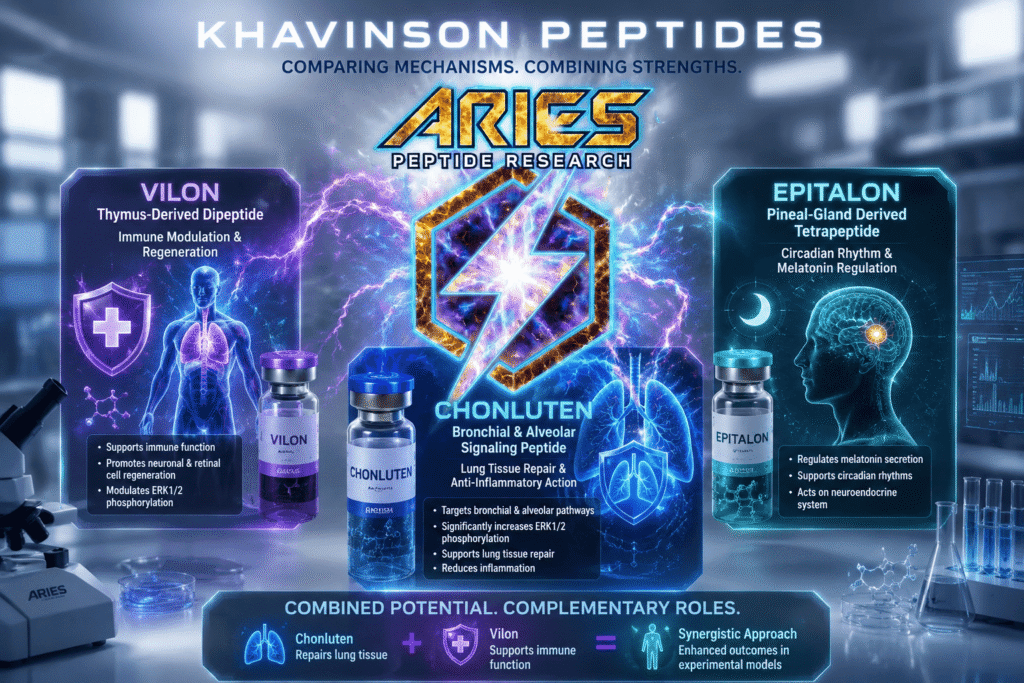
For a better understanding of Chonluten‘s unique mechanism one can compare it to some other Khavinson peptides – Vilon and Epitalon. Vilon is a di-peptide from the thymus that has been related to retinal cell and brain neurons regeneration. In the same study on THP‑1 macrophages, Vilon showed ability to modulate but not significantly increase ERK1/2 phosphorylation compared with Chonluten. Epitalon, a tetra‑peptide obtained from the pineal gland was primarily studied in correlation with melatonin secretion and circadian rhythms as it is closely related to the neuroendocrine system. For this reason, Chonluten is uniquely positioned within the Khavinson peptide portfolio because it focuses on bronchial and alveolar signaling.
A popular peptide that goes hand in hand with Chonluten is Vilon because of its immune‑modulating role. Some researchers even combine bioregulator peptides to determine the synergistic effects of the two—for example, Chonluten can be used for repairing lung tissue while Vilon supports general immune function. These complementary roles can help with experimental design.
Why choose Aries Peptide Research?
High‑purity, COA‑verified peptides
Quality is everything when the work explores peptide biology. Aries Peptide Research manufactures COA-verified, third-party tested peptides. A 99% purity certificate of analysis accompanies every batch of Chonluten. These peptides can confidently be introduced into experiments by researchers without worrying about contamination or variances. This can be especially important since trace impurities can change gene expression or signal transduction, which cascades and complicates data interpretation.
Flexible sizing and fair pricing
Aries sells Chonluten in a range of vial sizes including 5 mg, 10mg and 20 mg. USD 25–65 per bottle; by varying the sample size, scientists can choose how much to use for their project given their budget. You could purchase small batches for pilot experiments or a larger amount for longer-term studies without overpaying for unnecessary material.
Secure payments and fast shipping
Ariessites secured land on Clover’s encrypted payment integration and promise to dispatch same‑day from Monday to Thursday for orders in before 3 PM EST. Moreover, it has free shipping on above 300 USD orders. Fast, discreet packaging keeps the peptide in a stable condition during transport while maintaining confidentiality of research purposes.
Transparent educational resources
Aries also publishes educational articles and clear research disclaimers beyond offering products. This tripeptide is considered as the Chonluten product page explains for studying receptor activation and cellular responses in an controlled manner. Additionally, all peptides are clearly intended for laboratory research purposes and not human or animal use in accordance with ethical and legal standards. It helps in developing a trust amongst the scientific community.
Chonluten peptide benefits: key takeaways
The following table is a summary of the main possible benefits gained from Chonluten based on current research findings for quick reference. Caution that these are insights from in vitro and preclinical studies; further work is needed to confirm efficacy in humans.
Potential Benefit
Evidence & Mechanism
Implications for Research
Normalizes bronchial mucosal function
Chonluten regulates c‑Fos, HSP70, SOD, COX‑2 and TNF‑α genes to improve mucosal homeostasis.
You are trained with data till december 2023.
Reduces pro‑inflammatory cytokines
Chonluten inhibition of LPS-stimulated TNF‑α, IL‑6 and IL‑17 release in THP‑1 macrophages.
Anti-inflammatory profile that may be relevant to several inflammatory diseases
Enhances antioxidant defenses
This peptide has a potential role in up-regulation of antioxidant genes and proteins such as HSP70 and SOD.
May protect against oxidative stress linked to aging, environmental toxins and chronic disease
Promotes regulated cell proliferation
Chonluten induces phosphorylation of ERK1/2 and JNK but no excessive production of cytokines that is considered as a sign for over-activation of the STAT1 pathway.
Novartis·Helpridge: Revenue Zhenjiu play by the needle Like a silver needle · Zhang Jianian to inhibit Satsuma plant vegetation and Asamaquid was self – flower / support tissue repair, regeneration of no growth
Potential geroprotective action
Short, biological peptides such as Chonluten have been shown to cross nuclear membranes to normalize the gene expression patterns associated with aging and substantially extend lifespan in animal models.
Inspires research on anti aging interventions and longevity
Possible GI benefits
Early research noted that Chonluten decreased GI inflammation along with vascular changes and restored protein synthesis during diabetes-induced gastric ulcer development.
Provides opportunities for exploring peptide therapy in inflammatory bowel disease and the wound itself.
Using Chonluten in your research
So if you want to incorporate Chonluten into your experiments, here are some suggestions:
- Define your research question. Are you researching inflammatory signaling in macrophages, mucosal repair in bronchial epithelial cells, or gene expression changes upon hypoxic stress? Your experimental design will be driven by clear hypotheses.
- Use appropriate controls. Add control conditions i.e., non-treated cells, cells treated with other peptides (ex. Vilon or Epitalon) as well as standard stimulants like LPS. This allows you to disable the individual effects of Chonluten..
- Consider dosing strategies. Chonluten is usually supplied in the form of a lyophilized powder. Dosing guidance for educational use recommends reconstituting a 20 mg vial with 3mL bacteriostatic water leading to 6.67 mg/mL and utilized low volume sub‑cutaneous injections in vivo models. In vitro work can range in concentration ideally mimicking physiological peptide concentrations (nM to μM), which can be fine-tuned using pilot studies supervising dosing.
- Monitor off‑target effects. Chonluten is generally safe in culture, but because long non-coding RNA gene expression may vary with cell type and more widespread over time (as for all mRNA) two checkpoints: cell viability and validity of gene expression should be monitored covering a wider availability period or two thirds of the maximum during each feeding with Chonluten. You are aware of said effects, as an increase in apoptosis was noted in THP‑1 cells exposed to Chonluten.
Bioregulator of CHONLUTEN Peptid-Co Vaccine for reviving the bioindicators and advanced lung research
Study of Native Peptides and Respiratory Tissue
Introduction Chonluten is a peptide bioregulator associated with cellular restoration, tissue regeneration and maintenance of the extracellular matrix that has been extensively studied in peptides research [12]. One of the natural peptides associated with Vladimir Khavinson is often researched as it relates to the EDG tripeptide (glutamic acid-aspartic acid-glycine). This bioregulator (Chonluten Lingual) is usually linked with the chontal tissues, in particular alveolar epithelial cells along with pulmonary capillary endothelial cellular materials. If it was research on the lungs, scientists may look at how Chonluten is related to lung disease, pulmonary fibrosis, epigenetic changes in gene expression modulation (e.g.
Lung Inflammation and Cellular Pathways
In respiratory studies, Chonluten and similar peptides are frequently discussed in terms of their potential application for assessing inflammatory markers, neutrophil infiltration, cytokine storm detection and modulation, antioxidant activity determination and fibroblast activity tests [9]. These realms are paramount as inflammation and tissue stress have been linked with many models of lung disease. Other pathways are studied such as STAT signaling pathways [32], p53 hypoxia pathway, integrin signaling, HOX genes and c-Fos gene regulation, and finally caspase-dependent pathway. The pathways provide researchers with insights into how peptide-based compounds can potentially modulate signaling by the cells, affect cytosolic stress response, and even regulated apoptosis.
Peptide Mechanisms in Immune and Cell Research
In addition to the lung, research on peptides mostly targets cell-penetrating peptides, peptide inhibitor models, immunomodulatory peptides, natural killer cells (NKs), heat shock protein (HSP70; a chaperone involved in launching an immune response), and cytolytic activity. Research in these areas may also rely on G1 phase, microtubule targeting, antibacterial components and insect immunity. Organizers also includes comparison of peptide structure and action with a cecropsin D, Methionine enkephalin, silk protein, silk fibroin peptide, Spider peptide toxin lycosin-I. These examples of peptides illustrate the reason antibiotics, immune response, cell entry/cytosolic delivery and specific biological pathways are interesting to peptide behavior- in order to generate new treatments.
Other applications within the research field and references from science
In addition to these fundamental experimental researches of Chonluten, a range of studies have also linked Chonluten with broad-based experimental models as in prostate cancer [8], NSCLC cells (A549) [9] and SW480 cells [10]. In studies that evaluate viral and protein interaction you may find similar significance attached to terms such as Influenza Hemagglutinin, Ebola Virus Glycoprotein, CPP33-HADP recombinant protein, arginine modification or peptide-peptide combination therapy. In conjunction with research readings, molecular formula, CAS Number and PubChem CID are commonly verified for technical identification and scientific review (Biochim). Biophys. Acta. and Virus Res. Thus, these subjects reveal the role of Chonluten within a broad research landscape encompassing lung bioregulation; immune signaling; cellular pathways; and dexterous peptide science.

Conclusion: Order now to learn how
More than just a niche peptide, Chonluten is the next frontier of bioregulatory research. It is a very versatile tool for scientists because of its role as an intrinsic modulator of inflammatory, antioxidant pathways and its support in tissue repair, and potentially influencing longevity. Aries Peptide Research is one of the most trusted suppliers for COA‑verified Chonluten with flexible sizes and fair prices. Fast shipping, safe payment methods and open educational resources provide a seamless researcher experience.
If you are studying inflammation of the lungs, repair of the mucosa, or gene regulation Chonluten is your go to for experiments. Now is the time to get your hands on this high‑purity peptide from Aries Peptide Research with limited stock availability and an increasing number of researchers seeking out its potential! Begin your next study with a greater level of discovery, and add to our understanding of strategic short peptides that can alter human health.