
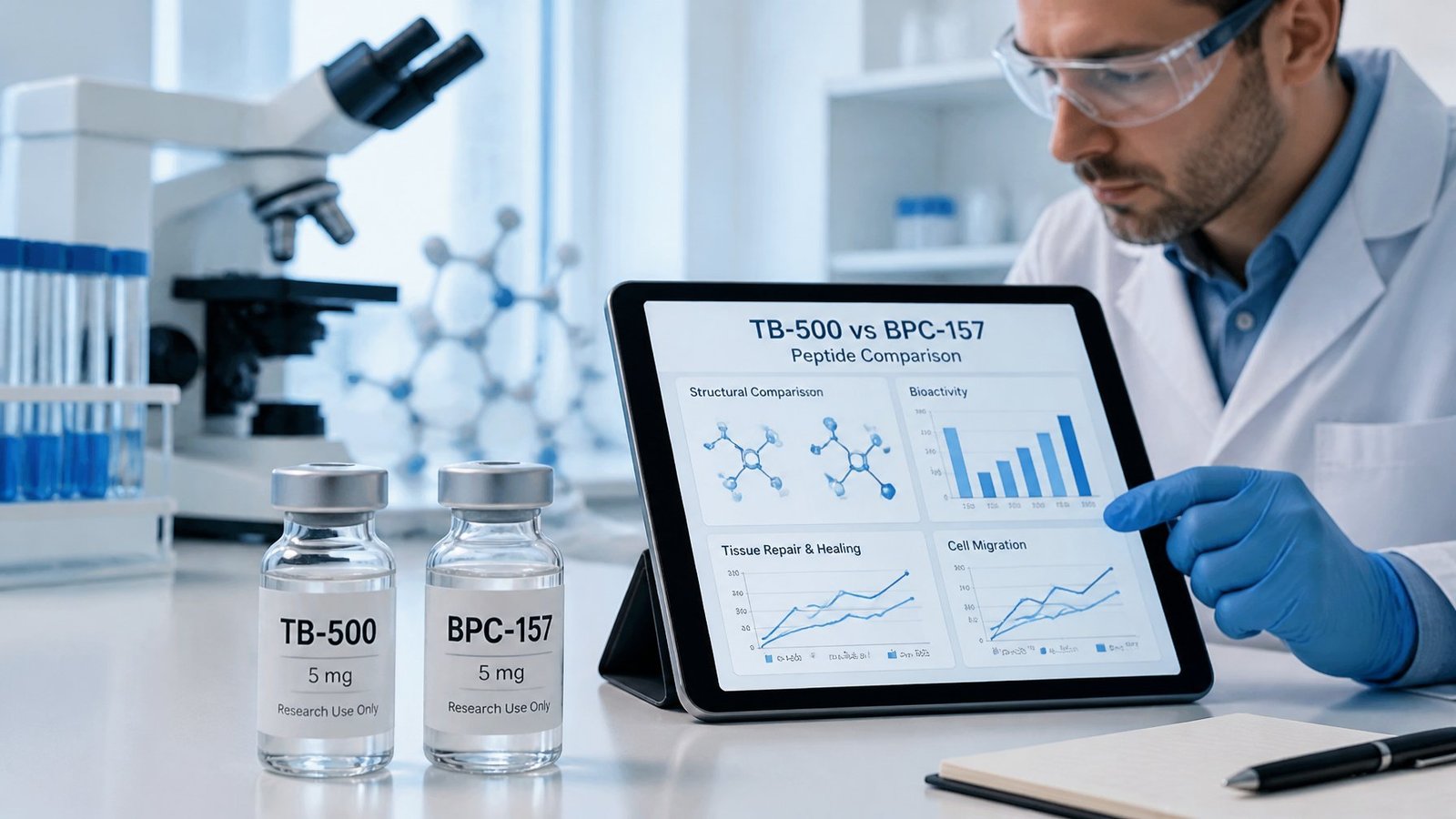
TB-500 and BPC-157 are frequently discussed together, but they are not interchangeable research compounds. They have different structures, proposed mechanisms, evidence bases, and experimental applications.
In TB-500 vs BPC-157 research, one of the most important distinctions is that many findings associated with TB-500 actually come from studies involving full-length thymosin beta 4. Researchers should not automatically apply every thymosin beta 4 result to the shorter TB-500 fragment.
BPC-157 has mainly been investigated in preclinical models involving fibroblast behavior, cell migration, angiogenesis-related pathways, nitric oxide signaling, gastrointestinal tissues, tendons, ligaments, and other experimental tissue models. However, its human evidence remains extremely limited.
This guide compares the two compounds from a laboratory-research perspective, including how to select an individual peptide, when a peptide blend may be appropriate, and what to evaluate before ordering research materials.
Research notice: TB-500 and BPC-157 are not FDA approved to treat, cure or prevent any disease. The products on this page are for Research Use Only and not intended for human or veterinary use.
TB-500 vs BPC-157 Research at a Glance
Comparison Point
TB-500
BPC-157
Research identity
Synthetic thymosin beta-4-related fragment, commonly associated with the LKKTETQ sequence
Synthetic 15-amino-acid research peptide
Broader research connection
Cytoskeletal regulation, actin-related processes and cell migration
Fibroblast migration, signaling pathways and experimental tissue models
Evidence limitation
Much of the broader literature concerns full-length thymosin beta 4 rather than TB-500 itself
Most evidence comes from cell and animal studies
Common laboratory interest
Migration assays, actin dynamics and angiogenesis-related endpoints
Fibroblast assays, tendon models, viability studies and pathway analysis
Best purchasing approach
Verify the exact sequence and do not assume it is full-length thymosin beta 4
Verify identity, purity, molecular data and batch documentation
Blend suitability
Better tested individually before combination studies
The right choice depends on the research question. A project centered on actin dynamics and cellular migration may justify investigation of a thymosin beta-4-related compound. A project focused on fibroblast behavior or experimental tissue-response signaling may be better aligned with BPC-157.
Neither candidate should be selected solely because of online popularity. The compound must match the protocol, cell model, analytical method and predefined endpoints.
Thymosin beta 4
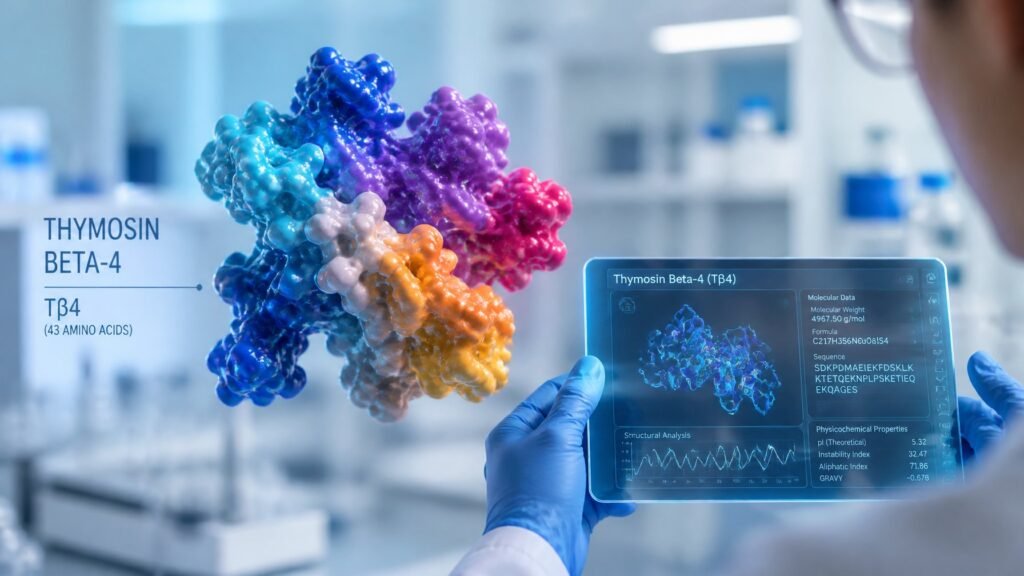
Thymosin beta 4 is a natural actin-binding peptide that shows potential as an agent in cellular mobility, cytoskeletal organization and tissue-response pathways.
TB-500 is often sold as a thymosin beta-4 fragment. It must not be referred to as ‘scientifically identical’ to full-length thymosin beta 4 unless the material provided and accompanying information authoritatively demonstrate such identity.
The difference is significant because the published thymosin beta 4 literature encompasses a larger range of evidence than does the direct TB-500 evidence base.
Full-Length Thymosin Beta 4 vs TB-500
Researchers should separate the following terms when reviewing studies:
- Thymosin beta 4: The full-length endogenous peptide investigated across numerous cellular and preclinical models.
- A less synthesized peptide variant that is in the same family as a specific area of thymosin beta 4..
- TB-500 product names: Commercial labels that may not always communicate the exact sequence, molecular weight or composition clearly.
A study using full-length thymosin beta 4 does not automatically validate the activity of a shorter fragment at the same concentration, under the same conditions or against the same endpoints.
Before purchasing TB-500 for research, request documentation identifying:
- Complete amino-acid sequence
- Molecular formula and molecular weight
- Batch-specific purity
- Analytical testing method
- Mass-spectrometry identity confirmation
- Counterion or salt form
- Recommended storage conditions
- Batch and manufacturing dates
A product listing that provides only a name and vial quantity leaves important experimental variables unanswered.
Why Researchers Study the Thymosin Beta-4 Pathway
Published research involving thymosin beta 4 has examined subjects such as:
- Actin sequestration and cytoskeletal regulation
- Endothelial-cell behavior
- Cellular migration
- Angiogenesis-related activity
- Oxidative-stress responses
- Inflammatory signaling
- Stem-cell behavior
- Experimental wound and tissue models
These areas make thymosin beta 4 relevant to mechanistic laboratory studies. However, researchers purchasing TB-500 should confirm that their hypothesis concerns the fragment being supplied rather than the full-length parent peptide.
Research purchasing takeaway: Choose TB-500 when its disclosed sequence and fragment-specific rationale match your protocol. Choose full-length thymosin beta 4 when the study is designed around evidence produced with the complete peptide.
Peptide blend
A TB-500 and BPC-157 peptide blend may appear convenient, but convenience should not replace experimental control.
When two compounds are introduced simultaneously, researchers may have difficulty determining whether an observed result came from:
- TB-500
- BPC-157
- An additive interaction
- A synergistic interaction
- An antagonistic interaction
- Changes in peptide stability
- Differences in solubility
- An impurity or degradation product
For early-stage studies, individual peptides normally provide cleaner data. Each candidate can be evaluated separately before a combination condition is added.
Individual Peptides or a Premixed Blend?
Order the peptides individually when the study requires:
- Separate dose-response curves
- Independent negative and positive controls
- Compound-specific stability testing
- Mechanistic comparison
- Independent statistical analysis
- Flexible experimental ratios
- Confirmation of each peptide’s identity
A premixed peptide blend may be considered when:
- Single-compound experiments have already been completed
- The interaction itself is the research question
- The ratio is clearly disclosed
- The combined material has batch-specific analytical documentation
- The protocol includes individual-compound control groups
- Blend stability has been evaluated under the study conditions
Researchers should avoid an undisclosed “proprietary blend.” Without the concentration or ratio of each peptide, the experiment may be difficult to reproduce or interpret.
Recommended Combination Study Design
A controlled in vitro comparison could include:
- Vehicle control
- TB-500 condition
- BPC-157 condition
- TB-500 plus BPC-157 condition
- Relevant positive control
- Untreated baseline condition
This design helps distinguish single-compound activity from a possible interaction.
A blend-only experiment cannot reliably answer which component produced the measured response. Purchasing separate, fully documented materials usually gives laboratories greater control over experimental ratios and future protocol adjustments.
Buying a Research Peptide Blend
Before ordering a blend, verify that the supplier provides:
- Exact quantity of each component
- Defined molar or mass ratio
- Batch-specific certificate of analysis
- Identity testing for both components
- Purity test results
- Storage and stability information
- Traceable lot numbers
- Clear research-only labeling
A lower price does not compensate for missing identity or purity information. Poor documentation can result in inconclusive data, failed replication and unnecessary repeat experiments.
In vitro comparison
A useful in vitro comparison should begin with a measurable hypothesis rather than a general expectation of “repair” or “recovery.”
TB-500 and BPC-157 can be compared through cell-based assays, but the selected cell model and endpoint must reflect the proposed mechanism being investigated.
Potential In Vitro Study Areas
Research Area
TB-500 or Thymosin Beta-4-Related Study
BPC-157 Study
Cell migration
Scratch assay or transwell migration
Scratch assay, fibroblast outgrowth or migration
Cytoskeletal response
Actin organization and cell morphology
Cytoskeletal changes associated with migration
Cell viability
Viability and cytotoxicity controls
Viability and cytotoxicity controls
Endothelial behavior
Migration and angiogenesis-related assays
Endothelial-signaling and angiogenesis-related assays
Fibroblast activity
Migration and tissue-response markers
Migration, collagen-related markers and signaling
Gene expression
Actin, migration and inflammatory markers
Fibroblast, nitric oxide and tissue-response markers
Protein expression
Cytoskeletal and pathway proteins
Migration, signaling and extracellular-matrix proteins
These endpoints are examples of research possibilities, not guaranteed biological effects.
Cell Migration Assays
Cell migration is one of the most relevant comparison areas because thymosin beta 4 and BPC-157 have both appeared in migration-related preclinical research.
A basic scratch assay can measure the change in an artificial cell-free area over time. However, scratch closure can reflect both migration and cell proliferation. Researchers may therefore need complementary testing, such as:
- Proliferation assays
- Transwell migration assays
- Live-cell imaging
- Cytotoxicity testing
- Cell-count normalization
- Morphological analysis
Without these controls, faster scratch closure should not automatically be interpreted as enhanced migration.
Viability and Cytotoxicity
Viability testing should be completed before interpreting pathway-specific results.
A decrease in cell number may create misleading migration, protein-expression or gene-expression data. Researchers should establish a concentration range that does not produce unacceptable cytotoxicity in the chosen cell line.
Relevant controls may include:
- Vehicle-only controls
- Untreated controls
- Positive cytotoxicity controls
- Multiple exposure periods
- Replicate wells
- Independent experimental repeats
Concentration-Response Research
A single experimental concentration provides limited information. A concentration-response design can help identify:
- Inactive ranges
- Potential response thresholds
- Plateau effects
- Nonlinear responses
- Cytotoxic concentrations
- Differences between the two compounds
The concentration range should be appropriate and justified by used assay, literature or pilot tests. It is unsafe to automatically extrapolate results from one cell type across all tissues or organisms.

Stability Within the Experimental System
Peptide stability can be affected by:
- Temperature
- Light exposure
- Oxidation
- Repeated freeze-thaw cycles
- Buffer composition
- Incubation time
- Proteases in the culture system
- Adsorption to laboratory surfaces
This becomes particularly important in a peptide blend, where the stability or solubility of one component may influence the other.
Document preparation time, storage conditions, incubation duration and handling procedures so the study can be reproduced.
Research Applications, Mechanisms, and Quality Standards
Laboratory Evaluation of BPC-157 and Related Peptide Pathways
Gastric pentadecapeptide body protection compound BPC 157 is studied as part of broader research into therapeutic peptides, tissue repair, wound healing, collagen synthesis, and musculoskeletal soft tissue responses under controlled laboratory conditions. Current experimental discussions explore how this peptide may interact with gastric juice, cell structure, receptor systems, metabolic signaling, and metabolic signaling pathways, while remaining distinct from growth hormone research. Preclinical models have also examined angiogenic signaling, VEGFR2 activation, angiogenic growth factors, and Angiogenesis pathways in relation to cardiac tissue, corneal injury, scar tissue formation, and possible neuroprotective properties. Because these findings have not established approved clinical applications, materials should be clearly labeled Research Use Only and sourced as research-grade peptides. Reliable suppliers should follow strict purity standards and provide transparent documentation covering peptide synthesis, HPLC testing, and batch-specific HPLC chromatograms so researchers can verify identity, purity, and consistency before beginning an in vitro study.
Which Research Peptide Should You Choose?
Choose the compound that most directly matches your hypothesis.
Consider TB-500 when:
- The study specifically concerns the LKKTETQ thymosin beta-4 fragment.
- The protocol investigates actin-related or migration-associated mechanisms.
- The supplier confirms the exact fragment sequence.
- Full-length thymosin beta 4 is not required by the experimental design.
Consider BPC-157 when:
- The protocol focuses on fibroblast behavior or migration.
- The selected literature and model specifically involve BPC-157.
- The research examines defined signaling or extracellular-matrix endpoints.
- The study recognizes that evidence is predominantly preclinical.
Consider purchasing both separately when:
- A direct TB-500 vs BPC-157 research comparison is planned.
- Individual and combined conditions will be tested.
- Flexible ratios are required.
- Compound-specific controls are necessary.
- The laboratory expects to repeat or expand the experiment.
Buying both peptides separately can provide more experimental flexibility than beginning with a fixed-ratio blend.
What to Check Before Buying TB-500 or BPC-157
A dependable research supplier should make product identity and testing information easy to review.
1. Batch-Specific Certificate of Analysis
A generic certificate vaccine may not reflect the lot being sold. Verify that the lot number on the certificate matches with the product.
2. Purity Testing
Inspect chromatographic purity data, including the testing method. Having a purity percentage without having the chromatogram and method is like providing limited analytical era context.
3. Identity Confirmation
Mass spectrometry or another appropriate analytical method should support the stated molecular identity.
4. Complete Product Information
The listing should disclose the peptide name, sequence, quantity, form, storage requirements and lot details.
5. Transparent Research Labeling
The product should be marketed consistently for laboratory research, without dosage instructions, self-administration guidance or promises to treat health conditions.
6. Reliable Packaging and Handling
Packaging should support stability during storage and transport. Researchers should also check the supplier’s replacement policy for damaged or improperly sealed materials.
Order According to Your Research Protocol
The best purchasing decision is not based on which peptide has the strongest online claims. It is based on which compound provides the closest match to the experimental question.
For a controlled comparison, order individually documented TB-500 and BPC-157 materials, establish baseline conditions, test each compound independently, and add a combination group only when the study design requires it.
Suggested product links:
- [View TB-500 Research Product]
- [View BPC-157 Research Product]
- [Compare TB-500 and BPC-157 Products]
- [View Research Peptide Blend]
- [Request Batch Documentation]
Select research materials supported by transparent sequence information, verifiable analytical testing and batch-level documentation. Better documentation makes it easier to plan, interpret and reproduce your research.
Frequently Asked Questions
1. Are TB-500 and BPC-157 the same peptide?
No. TB-500 is also labelled as a synthetic fragment of thymosin beta 4, whereas BPC-157 is a independent synthetic 15-amino-acid peptide. They fell short on their sequences, research histories and suggested mechanisms.
2. Is TB-500 the same as full-length thymosin beta 4?
No.TB-500 is generally referred to as the LKKTETQ fragment of thymosin beta 4. Because fragments of thymosin beta 4 may not exhibit identical biologic properties, it is strongly recommended that researchers do NOT infer the complete findings associated with full-length thymosin beta 4 to those TB-500 without compatible evidence for specific fragments.
3. Should researchers buy a peptide blend or separate peptides?
Separate peptides usually provide better experimental control. They allow researchers to test each compound independently, establish concentration-response relationships and create custom combination ratios. A blend is more appropriate when the interaction between the compounds is the defined research question.
4. What can researchers measure in a TB-500 vs BPC-157 in vitro comparison?
Potential endpoints include cell migration, viability, cytotoxicity, cell morphology, gene expression, protein expression and selected angiogenesis- or extracellular-matrix-related markers. The endpoints should be chosen according to the cell model and hypothesis.
5. Are TB-500 and BPC-157 approved for human use?
No. They are not FDA-approved treatments for human use. FDA has also identified limited safety information and potential concerns involving peptide impurities, characterization and immunogenicity. Research products should not be consumed or administered to humans or animals.
Contact Our Research Support Team
Need help choosing between TB-500 and BPC-157 for your laboratory study? Contact our research support team to ask about product specifications, batch documentation, HPLC testing, availability, and ordering information.