
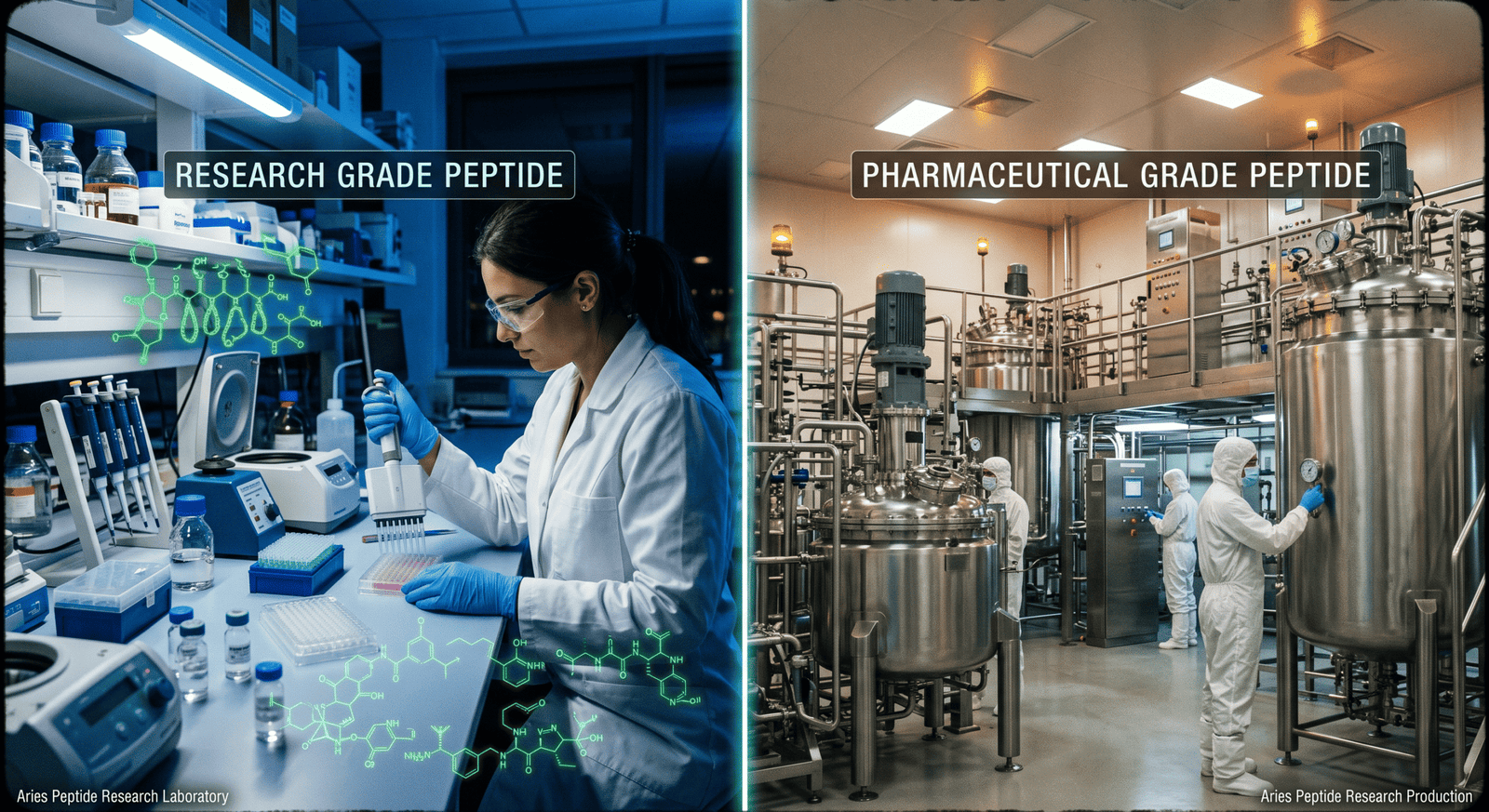
Peptides are a massive topic in today’s lab spaces. Scientists use them constantly for all kinds of molecular tests, chemistry setups, and biological projects. But let’s be honest, all the constant noise around these compounds makes it way too easy to mix up basic research tools with actual medical grades. If you just hear the names, you would think they are the exact same thing. In reality, though, they live on completely opposite sides of the scientific timeline.
Just think about it this way. When a lab team wants to buy peptides online, their first real step is finding a dependable research peptides USA supplier. They do this because research-grade items are meant only for early benchwork and lab experiments. Medical or pharmaceutical peptides are totally different. Those variants have to go through a long, multi-year marathon with human clinical trials and massive factory regulations. Spotting this clear boundary helps you read scientific papers without getting mixed up.
It really doesn’t matter if you are diving into raw lab data, scanning through published textbooks, or just trying to wrap your head around peptide basics. Keeping these two categories distinct simply gives you a much better starting point.
Why One Peptide Can Carry Different Names
The main reason for all this confusion comes down to timing. The exact same chemical molecule gets labeled in entirely different ways depending on where it actually stands in its development cycle.
Think about it: every single new peptide gets its start on a basic lab bench. During this preliminary phase, the team isn’t even thinking about making a finished medicine for a drugstore shelf. Instead, they are just trying to sort out basic, day-to-day questions like:
- Can we accurately identify this specific peptide?
- Does the compound stay stable under standard lab storage setups?
- Does our analytical testing back up the reported purity numbers?
- Is there enough real data here to justify taking the next step?
These early tests help researchers map out the basic traits of the molecule. This builds a data floor that future projects can use. If the numbers look good over time, that specific compound might scale up into the formal pharmaceutical pipeline, where testing demands and regulatory stress multiply. This is why treating these two distinct terms as interchangeable is a clear mistake.
The Actual Purpose of Research Peptides
To put it plainly, research peptides are built to solve scientific mysteries, not commercial ones. Their only job is to drive laboratory investigation, giving scientists a safe way to track biological pathways, observe molecular interactions, and test raw ideas inside a controlled room.
Every lab run brings a brand-new clue to the table. Sometimes the metrics support your original theories perfectly, but other times they just toss a complete wrench into the gears. In the scientific world, both of these outcomes are actually a win since they sharpen your direct focus and point out exactly where to look next.
Instead of making massive proclamations off a single good test, serious researchers look closely at experimental design, the precise tools used, and whether the data can be successfully duplicated. Lasting progress relies entirely on data that can be double-checked and verified by an independent lab.
Paperwork is a huge piece of this trust. Before a scientist even thinks about popping open a vial, they thoroughly review paperwork like a certificate of analysis peptide (COA) to double-check their materials.
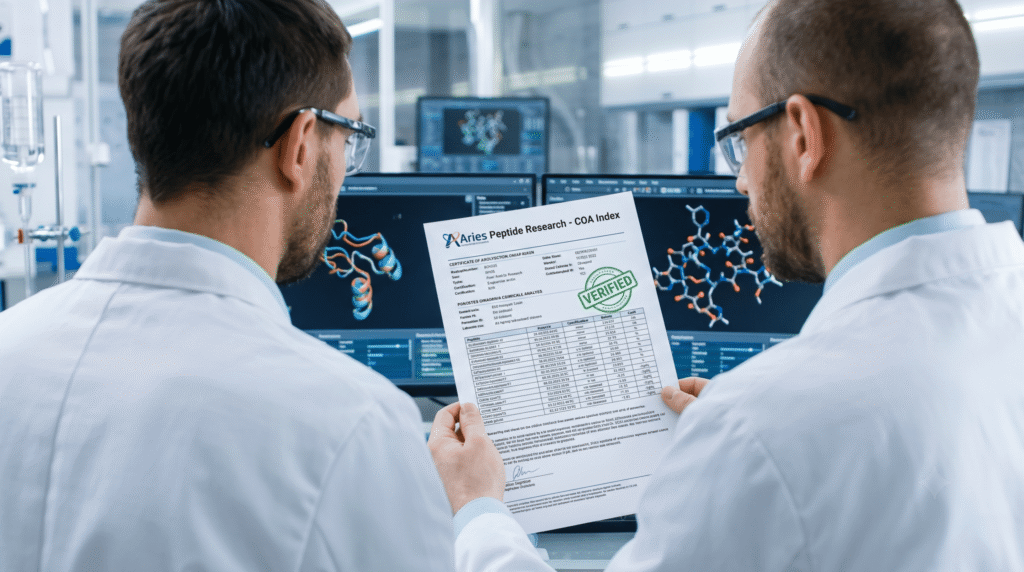
Resource Link: If you want to know exactly how to break these sheets down, you can read our full breakdown on How to Read a Peptide Certificate of Analysis (COA).
Pharmaceutical Grade Is a Whole Different Story
Even when a basic lab compound features the identical amino acid blueprint as a clinical version, turning it into an actual prescription drug requires a massive, top-tier operational shift.
Before a molecule can ever be sold for real patient care, it has to survive years of brutal testing. We are talking about clearing deep molecular screenings, massive manufacturing checks, strict quality setups, real human clinical trials, and heavy regulatory oversight from agencies like the FDA.
The honest truth is that only a tiny fraction of these raw candidates ever make it to that final finish line. A lot of compounds look incredible when you are just running early bench tests, but they never end up as approved medical products. Realizing this gap prevents people from looking at early lab notes and thinking they work as definitive medical proof.
Quick Comparison: Side-by-Side Breakdown
The molecular bones might be the same, but the execution and standards are worlds apart. Here is the direct breakdown:
| Feature | Research Peptides | Pharmaceutical Peptides |
| Lab Setup | Handled almost entirely for standard benchwork and early testing runs. | Made explicitly for formal medical treatments and commercial market rollouts. |
| Main Job | Built to fuel experimental studies and collect basic data. | Pushed through intense human testing and heavy federal evaluations. |
| Testing Goal | Focuses completely on mapping out how the molecule behaves. | Production pipelines must line up perfectly with strict compliance laws. |
| Final Results | Yields raw scientific facts and foundational laboratory reports. | Locks down the clinical proof needed for formal government approvals. |
| Real-world Use | Used by scientists to study core biological mechanisms. | Developed to directly manage or treat confirmed health conditions. |
This tells us that research options act as the opening chapter of a discovery, while pharmaceutical variants represent the highly polished, finished book.
Navigating the Compliance Landscape
The rules framing these two tiers are completely separate. Research peptides stay inside controlled academic or private spaces where the main target is generating raw, unbiased data. The team wants to learn how the compound behaves, not package it for immediate patient use.
Pharmaceutical channels, however, face a wall of oversight. Before a formula moves an inch toward a public pharmacy, developers have to show flawless batch consistency, tight quality controls, zero safety threats, and deep clinical efficacy. Recognizing these split paths helps prevent confusing an early lab compound with a fully verified medical treatment.
Why Quality Control Matters at the Bench
You simply cannot run solid experiments if you are working with bad materials. It is really that straightforward. Here at Aries Peptide Research, we truly believe that opening up and sharing unfiltered analytical metrics is the single best way to back the scientific community. When you have a crystal-clear profile of your compound, it builds deep trust in your numbers and helps other teams duplicate your success.
Scientists usually depend on two primary tools to double-check their vials:
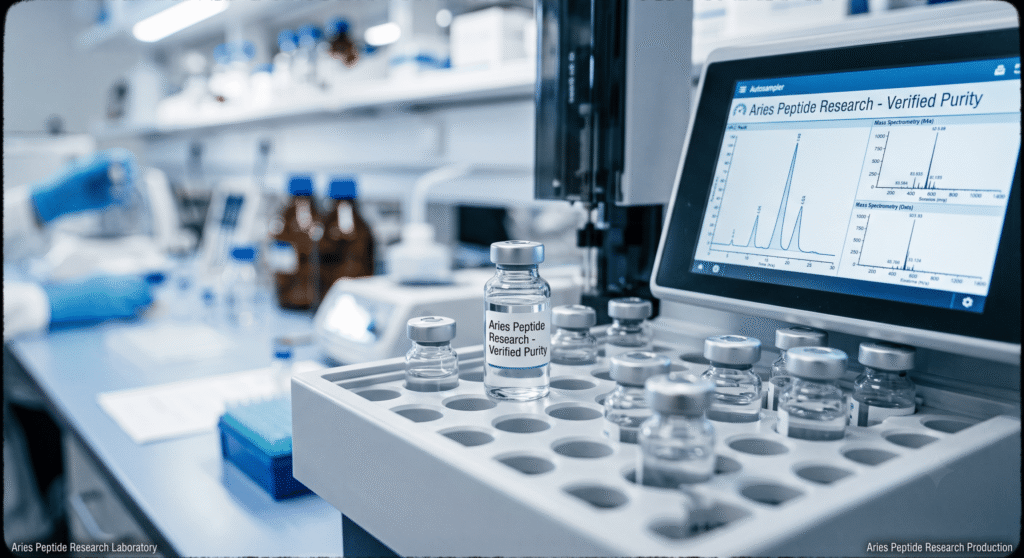
1. HPLC (High-Performance Liquid Chromatography)
When it comes to analyzing peptides, HPLC serves as the absolute workhorse for labs everywhere. This method breaks apart the unique elements hidden inside a sample, allowing researchers to view the exact composition and calculate the final purity percentage. Running this crucial check lets a team verify batch consistency before wasting time on a flawed experiment.
Whenever your team is trying to lock down high purity peptides, having a clean HPLC readout gives you the transparency you need to back up your data.
Resource Link: To see exactly how purity profiles and storage tactics work out in real-world setups, feel free to explore our guide:BPC-157 Research Peptide: Mechanism, Purity Standards & Storage Guide.
2. Mass Spectrometry (MS)
Mass Spectrometry is all about answering the question of identity. Instead of just showing how pure a sample might be, MS checks the exact molecular mass to prove that the peptide actually matches the target chemical structure. When you stack HPLC and MS together, you get a bulletproof look at quality that a single testing run just cannot match.
Breaking Down the Certificate of Analysis (COA)
All of these intensive testing results eventually get summarized onto a single document known as the Certificate of Analysis (COA). It is basically a vital piece of paperwork that tracks the history and quality of a specific production batch.
A truly dependable COA needs to clearly display:
- Specific batch identification numbers to track the lot
- Verified purity percentages from the lab tests
- The exact analytical gear used during testing
- Clear guidelines for safe, long-term storage
- Fresh, valid testing dates
- Raw product specifications to match the formula
Checking this data is standard protocol for any serious lab setup. For teams specifically scouting for COA verified peptides, prioritizing this review process is just a core part of doing clean science.
The Real Test of Science: Can You Replicate It?
A brand-new discovery doesn’t amount to much if another lab can’t get the exact same numbers using the identical setup. That is exactly why the peptide community puts such a massive premium on fully open reporting, fixed testing steps, and incredibly detailed lab notebooks. Being able to actually replicate work lets everyone cross-reference data globally, validate theories, and figure out what questions to ask next.
At the end of the day, reliable research isn’t built on a single lucky run. It depends entirely on whether the broader community can verify those exact same results through repeated trials.
Common Mistakes and Misconceptions
Since people often talk about lab options and actual medical treatments in the exact same conversation, the boundaries between them get incredibly blurry real fast.
- Mistake 1: Assuming a Lab Compound Is an Approved MedicineJust because there is a mountain of published lab studies out there does not mean a specific compound has cleared clinical safety loops or won formal market backing. Lab papers are written to look closely at basic chemical actions, nothing more. Taking a raw molecule from a basic lab bench and turning it into a finished drug for actual patients requires massive capital, deep safety logs, and formal human trials.
- Mistake 2: Treating a Single Study as Absolute ProofTrue science is never an overnight declaration; it functions as an ongoing, shifting conversation. A single study is really just one voice in a huge room. Real scientific consensus only develops when the broader community evaluates multiple trials over a long stretch of time, weighs the limitations, and successfully repeats the exact same work.
Frequently Asked Questions
What is the main difference between a research peptide and a pharmaceutical one?
It mostly comes down to their final purpose and regulation. Research peptides serve as basic tools to map out new biological insights inside a lab setup. On the flip side, pharmaceutical variants are finished medical treatments that have already gone through intense human trials and cleared strict government approvals for public use.
Why are research peptides so important to science?
They give scientists a reliable way to track complex cell pathways, test out fresh chemical profiles, and stack up the foundational data needed to push the life sciences forward.
Which testing tools do labs depend on the most?
Teams usually lean on HPLC to check the exact purity levels, Mass Spectrometry to verify the chemical identity, and complete COA documents to review the overall quality of a batch.
Why does the purity percentage matter so much?
Keeping purity levels exceptionally high ensures that your final results remain accurate and free from outside contaminants. This is exactly what makes your entire experimental project completely reproducible for other labs.
More Resources
For anyone trying to sort through the technical side of peptide metrics and quality controls, these write-ups break down the details nicely:
- How to Read a Peptide Certificate of Analysis (COA)
- BPC-157 Research Peptide: Mechanism, Purity Standards & Storage Guide
- Peptide Bioregulators: Scientific Applications, Safety, and Clinical Potential
- AOD-9604 Research Peptide: Real Science vs. Market Hype
Conclusion
Even though they share the exact same amino acid foundations, research peptides and pharmaceutical variations live in completely separate spaces. One sets our baseline of knowledge via raw benchwork, while the other faces the grueling climb to becoming a safe, scalable medicine. Keeping these two tracks distinct ensures we have smarter, much more accurate conversations about where peptide science is heading next.
Sources & Literature
Published Research
- Peptide Therapeutics: Current Status and Future Directions — Published back in Drug Discovery Today (2015).
- Therapeutic Peptides: Historical Perspectives, Current Development Trends, and Future Directions — Found in Bioorganic & Medicinal Chemistry (2018).
- The Future of Peptide-based Drugs — Featured in Chemical Biology & Drug Design (2013).
- The Emergence of Peptides in the Pharmaceutical Business — Detailed in EuPA Open Proteomics (2014).